Exploring the Future of AI

Exploring the Future of AI

Exploring the Future of AI:

In today’s world, technology has become an integral part of our lives, transforming how we live, work, and communicate. From smartphones to social media, technology has revolutionized the way we interact with the world around us, making our lives easier, more efficient, and more connected than ever before. Automation has given us more time than ever before to pursue our hobbies and interests.

Despite not always feeling like it, we have more free time now than ever before, allowing individuals more leisure time to socialize, create, and unwind. In recent years, the advancement of automation has been largely driven by the emergence of artificial intelligence (AI). The rise of AI has led to significant improvements in efficiency and productivity across various industries. With the ability to automate mundane tasks that people would rather not do, AI has become an increasingly popular tool for people around the world.

In recent years, there has been a great deal of interest in the field of AI. However, people’s views on AI differ according to their familiarity and knowledge. In this article, we will examine how different people’s familiarity with AI leads to varying interpretations of this field. This article compares and contrasts popular beliefs about AI with the truth about this emerging technology. The future of AI in the workplace is also discussed, along with its potential in Bangladesh.

Perception vs reality

AI is a tool that has the potential to enhance human capabilities and boost productivity. AI is a term used to describe the ability of a computer system to perform tasks that typically require human intelligence. These tasks can include decision-making, problem-solving, and learning new information. AI relies on various techniques, such as machine learning methods, neural networks, and natural language processing, to analyze data and generate predictions.

If the general public had the impression that the technology was unreliable, they would be less inclined to trust it.

AI’s future is a mystery. “One can imagine such technology outsmarting financial markets, out-inventing human researchers, out-manipulating human leaders, and developing weapons we cannot even understand,” stated renowned scientist Stephen Hawking. Is robot control a real threat? How much should we worry?

Let’s examine many prevalent AI danger beliefs and see if they’re accurate.

  • Robots will rule

  • The idea dates from 1965 through 2023 to 2045. We’re not there yet. AI  has been used in a narrow range so far, and while we’ll continue to improve technology, robots taking over in 50 years seem doubtful. The New York Times states: “You won’t be obsolete for a long time, if ever”
  • We’ll be replaced by robots

  • AI will change work. How firms and governments react to AI’s growing ability to manage human occupations will determine the impact. Two-thirds of Americans expect robots to do most human work in 50 years, according to Pew Research. But technology’s expected impact on jobs is different, comparing studies on how many jobs technology will kill (and create) shows that no one knows. Technology Review states: “Predictions range from optimistic to devastating, differing by tens of millions of jobs even when comparing similar time frames.” According to Gartner, AI will eliminate 1.8 million jobs by 2020 but create 2.3 million
  • AI will invade privacy and cause persistent surveillance

  • Video algorithms can detect and track humans and objects. Google, MIT, IBM, and DeepMind are constructing video databases for facial recognition and behavior analysis. Current AI technology can replicate human voice and alter video with outcomes indistinguishable from real life, threatening privacy, safety, and honest news reporting.
  • AI is great at spying and invading personal data, but scientists argue computers can’t understand media like humans. We’re getting closer to programmers that can watch and participate in surveillance and data systems.

AI technology can be scary, yet it’s easy to trust sophisticated tech that can surpass human abilities. Better tech that solves human problems requires transparency.

The impact of AI on the work domain

One of the fastest-growing industries today is AI. The ultimate goal of this field is to create systems as sophisticated as the human brain.

  • Financial Services: AI was early adopted in this industry. Data and difficult use cases are the reasons. The history of banking and finance shows that this sector is vital to human development and takes a lot of effort to avoid fraud and failure. Avoiding this requires a well-trained computer, AI algorithms and initiatives to protect the system and generate big profits. Designing digital payment channels with AI agents
  • Health care: AI has a big impact on health care. We can see that AI is used in various kinds of health care procedures, from daily ones to high-level ones that require accuracy. The fit band or iWatch, which collects data from body sensors, is a simple example of AI in health care.
  • Education: AI has expanded education’s potential. AI can grade instructional content faster and easier than humans. AI may also automate processes, personalize learning, universally access, create smart content, teach, optimize class performance, and provide 24/7 assistance. Online classes are one of the best instances of AI in education.
  • E-Commerce: AI works well in e-commerce. AI currently attracts and boards customers safely through E-commerce. AI can forecast demand and supply, assist customers, recommend products, personalize chatbots, and more in e-commerce. Amazon, the largest e-commerce site, develops AI to stay profitable.
  • Agriculture: AI is now employed for crop monitoring, predictive analysis, and robot tasking in agriculture. Soil, seed, and atmospheric characteristics are measured using various systems. Drones can distribute water, fertilizer, and detect crop defects using AI

AI is improving every field daily. As we mentioned the market potential, every organization would invest time and money in the industry to improve their work and earnings.

Getting ready for the next generation of AI

In order to maintain a competitive edge in the employment market, it is necessary to acquire these abilities.

Placing an emphasis on creative thinking and emotional intelligence: As was said previously, AI is unable to reproduce the abilities associated with creative thinking and emotional intelligence. To complement AI and maintain a competitive edge in the workplace, it is imperative to place a strong emphasis on the development of these talents.

Investing in AI Research: Both private companies and public administrations need to put money into AI research if they want to remain at the forefront of AI development and adoption. In order to accomplish this, investments will need to be made in AI startup companies, research institutions, and cooperation with other nations.

Developing Ethical and Legal Frameworks: As AI becomes more pervasive in society, there is a need to build ethical and legal frameworks to guide the development and use of the technology.

ChatGPT and its Future

The use of chatbots by businesses to communicate with their customers has increased dramatically in recent years. Using natural language processing, ChatGPT may provide responses to text inputs that sound disturbingly human.

Textual communication predominates in the realm of extension and operations for ChatGPT. Thanks to its modular design, the product works with numerous messaging apps. These include Facebook Messenger, Slack, and Telegram. Using ChatGPT, you can provide assistance, address frequently asked questions, and carry on discussions with clients across many channels. The speech-generating models developed by OpenAI have made it possible to integrate ChatGPT with other voice-based communication methods in addition to text. The availability of speech-generating models paved the way for this.

OpenAI regularly releases updates to the model, which contribute to ChatGPT’s ever increasing accuracy. But it has limitations and can make mistakes, the same as any other machine learning system. One of ChatGPT’s limitations is how reliant it is on the quality of the training data provided. Therefore, it is crucial to curate and monitor the training data to ensure ChatGPT produces correct and ethical replies.

The potential for ChatGPT to transform the way humans interact with machines is enormous. Because of its ability to understand and respond to natural language, it can provide clients with fast, efficient, and personalized service.

AI in Bangladesh

Bangladesh is still in the early stages of AI research, with only a handful of uses for the technology across a wide range of industries. However, businesses and the government are increasingly showing an interest in AI, and there are initiatives underway to increase AI use across the country.

Bangladesh is not as advanced in its AI preparations as more developed nations like the United States, Japan, or China. However, businesses and the government are increasingly showing an interest in AI, and there are initiatives underway to increase AI use across the country. The government of Bangladesh has established the Bangladesh High-Tech Park Authority and taken other measures to foster the growth of the country’s technological sector.

In terms of AI implementation, Bangladesh lags far behind India. India has become a leading hub for AI thanks to its growing number of AI-related firms and active AI research community. The Indian government has also taken initiatives to expand the country’s AI industry.

By Ahmed Shoyeb Iqbal

An Opportunity Worth Milking

An Opportunity Worth Milking

An Opportunity Worth Milking:

There is no doubt that the dairy sector is one of the most important economic contributors in Bangladesh. From a very humble beginning to growing into a sizable market, the rise of the dairy industry in the country is certainly commendable. However, even after increasing supply and trying to keep pace with the world dairy market, Bangladesh is still incapable of fulfilling the dairy demands of the whole nation. With a few gaps here and there, there is still scope for improvement in this sector.

From implementing innovative and modern technologies to improving farming practices and allocating more budget, there are more than a few factors which can be put into practice for Bangladesh to become a leader in the world market.

Size matters

The dairy market is one of the most important sectors in Bangladesh. Even though there have been several economic shocks in recent years, this sector still maintains constant growth and adds more to the overall economy. According to the Department of Livestock Services, the dairy market size in Bangladesh is estimated at $2.47 billion, as per IDLC. This market is expected to increase by over 5% every year.

Even though the market size is quite big and has a lot of potential, the demand and supply of dairy products aren’t proportional. While the market imposed a demand of 152.02 lakh metric tons of milk in the financial year 2020–21, the produce was just 119.85 lakh metric tons against the demand. The gap was almost 32.7 lakh metric tons in the year, which is fulfilled by importing dairy from the rest of the world.

Deman & Supply of Milk

Fig: Demand and supply curve of dairy in Bangladesh

Even though milking production in the country has grown significantly, a gap between the demand and supply always remains because of the increasing demand by the nation.

Filling the gap

Bangladesh was ranked the 23rd top milk producer country in the world. With a production of 130.74 lakh tons of milk in 2022, the country meets the majority of demand by its people.  However, as it can’t fulfill the complete demand for dairy, Bangladesh needs to import a significant amount of powdered milk and other dairy products from all over the world, namely Australia, New Zealand, Holland, Denmark, and Poland.

From powdered milk to butter, cheese, yogurt, and other dairy products, the country imports a variety of dairy items to meet the nation’s requirements completely.

How much does Bangladesh spend on dairy imports? 

Bangladesh has a growing demand in the dairy market. However, local producers cannot completely meet the demand of the nation. And therefore, the government needs to import dairy from all over the world to fulfill the daily dairy needs of the people.

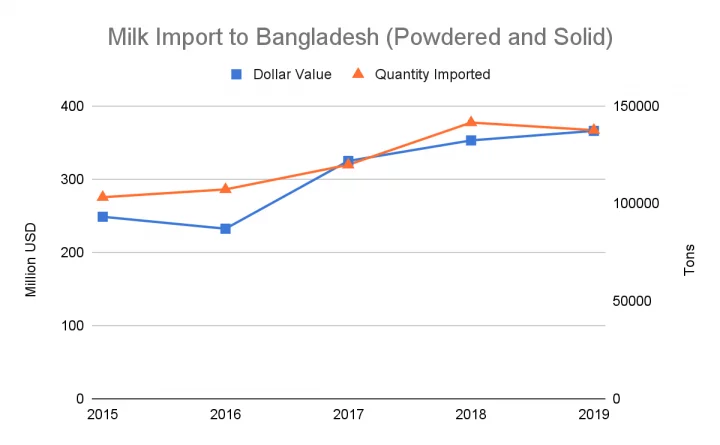
Milk importsMilk imports – Bangladesh Bank

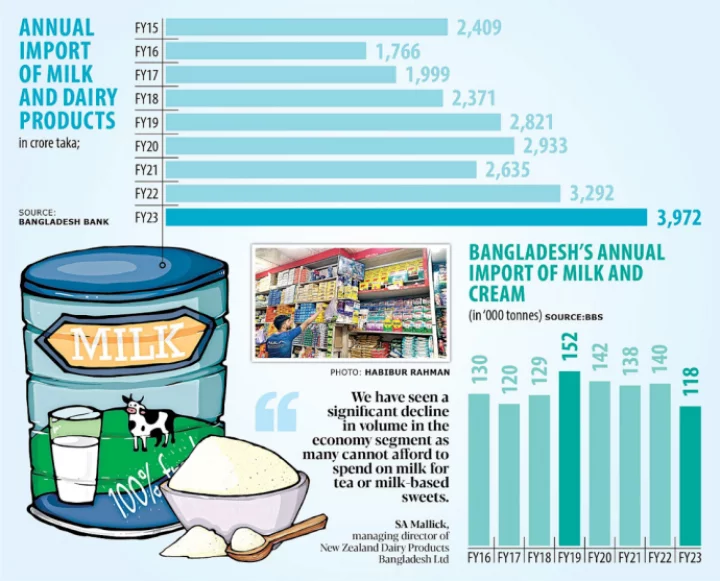
According to a Bangladesh Bank report, the country spent nearly $37bn (Tk4,000 crore) in 2023 to buy powdered milk and other dairy products from other countries.

Although the amount Bangladesh spent on dairy imports was quite high due to inflation and the increasing dollar rate, the volume was lower than in the previous years. During the fiscal year of 2022-23, our country imported 118,000 tons of milk, which was nearly 16% lower than the volume imported the previous year.

The drop in imports isn’t only for an increase in the production level but also for a decrease in demand. Because of increasing costs, household’s consumption of powdered milking has decreased significantly.

Becoming self sufficient

Bangladesh has shown commendable growth in the dairy sector in the past couple of years. However, even after consistent growth, the nation is still not self-sufficient and, hence, has to import dairy items from the rest of the world.The government should allocate more budget in the field to accelerate growth. Even though the estimated investment in the local dairy sector now is over Tk 90,000cr, the government is launching a TK4,280cr project to improve the dairy sector. Funded by the World Bank, this project (the Livestock and Dairy Development Project) will merge traditional methods with modern technologies to ensure it is not only self-sufficient but can also export dairy products

  • An increase in milk production is the key. Bangladeshi farmers and dairy producers often face a lack of farming resources, like land, feed, and freshwater for dairy animals. All these factors lower milking production significantly, creating a gap between demand and supply. The concerned parties and government must take the initiative to provide all the necessary resources to increase milk production quickly
  • Maintain a consistent tariff rather than increasing it every year — increasing tariffs in the dairy sector has become a concern for the farmers and the stakeholders alike. Because of high tariffs, they seem less interested in investing in the farms rather than not. The government should, therefore, take necessary actions to maintain an affordable tariff

By 2030, the demand for milk will increase to 17.22 million tons (172.2 lakh metric tons) in Bangladesh. With the current production rate of 119.85 lakh metric tonnes, the nation must adopt effective solutions to increase milk production to meet the ever-growing milk demand.

How Amul fulfilled India’s dairy demands while also exporting

The Indian dairy market is huge. Contributing 24.64% of global milk production in the year 2021-22, India has a market size of $26.11bn and holds the first position in the world. From producing milk (both fresh and powdered) to making butter, cheese, yogurt, and many others, the dairy sector in India is big and diverse. And because of such diversity and capability, this sector is expected to reach $35.96bn by 2029.

Even though there are thousands of small, medium, and large farms all over the nation, Amul has been one of the largest and most prominent companies in the Indian dairy sector. In fact, Amul plays the most vital role in fulfilling the country’s dairy demand while also exporting all over the world. This company exports milk, cheese, butter, and many other dairy products to major and minor countries in the world to help them meet their dairy demand.

How did Amul achieve such success?

Well, this company introduced a cooperative model of dairy farming in India to improve production significantly. The model involves a group of small farmers who work together with all their resources to maximize milk production as much as possible. This model not only showed a substantial rise in milk production but also increased the incomes of small farmers.

Besides influencing small farmers, Amul also introduced various training programs and provided improved veterinary services and animal feed to improve the quality of milk while also raising production. In addition to fresh milk, Amul also prepares processed milk products (powdered milk, cheese, butter, and yogurt) to add versatility to India’s dairy market.

The need for government and non-government initiatives 

There is no doubt the dairy sector in Bangladesh is slowly but surely growing and making a mark in the economy. However, it’s not growing as fast as it should and that’s mainly because of a lack of knowledge, finances, and better farming practices. Both government and non-government bodies in the country should take up and implement more than a few efficient actions to benefit this ever-emerging sector of the economy:

  • For instance, the government and related parties should implement initiatives to prevent livestock illness successfully. Diseases like foot and mouth diseases and worms hamper hygienic practices and reduce milk production considerably
  • Government and non-government parties must also invest in breeding technology. A mixed breed cattle gives 5 liters more milk than any local breed. Increasing the number of mixed-breed livestock would definitely increase the milk production rate
  • Attention needs to be paid to building and improving processing facilities. The absence of processing facilities keeps the nation from producing powdered milking and many other dairy products. With modern manufacturing units, Bangladesh could process dairy products and reduce the need for import
  • The government should help establish a better communication channel between farmers and buyers. This will allow the farmers to get better access to the market and get a better price for their products


Connecting producer and buyer

Technologies and innovation play an important part in helping the dairy industry in Bangladesh grow. From helping to grow mixed breeds and enhancing safety and production to market access and sustainability, technology and newer innovation can help the dairy sector flourish like never before.

Here are a few ways technological innovations can help the dairy industry in Bangladesh grow:

IoT and Sensors:

Farmers can use Internet of Things (IoT) devices and sensors to monitor various aspects of their dairy farm and make informed decisions. From finding out about milk production to enquiring about cow health and the overall environment, the data collected through these technologies can be used for better-quality products

Automated Milking System:

Manual milking takes a lot of time and labor hours. If the farmers in the country introduced advanced milking systems in their farms, the machine would automatically milking the cow and save a lot of money and hard work

Better Feeding:

Robotic feeding system has shown revolutionary improvement in the dairy sector. The government of Bangladesh should introduce this technology in the farms to feed the livestock better and quicker and also to cut feed waste significantly

Maintaining Sustainability:

Modern technologies and innovations allow farms to reduce their environmental footprint and manage better farming practices. With better farming practices, farms can not only contribute to a more sustainable environment but also improve production and reduce costs

Better Communication:

Phones, smartphones, and other devices made communication easier than ever. Farmers can use these devices to establish contact with buyers and other interested parties and increase sales in no time. From making direct calls to exploring social media platforms and other e-commerce sites, the contact channels are ever versatile and convenient

The dairy sector in Bangladesh is ever-expanding and emerging as a force to be reckoned with as far as industries go. Even though the industry has yet many hurdles to overcome, with their determination and an urge to meet the nation’s demand, the dairy market is slowly but surely improving. While the farmers and associated parties are implementing better farming practices, the government of the nation is allocating more resources to become self-sufficient in the dairy sector.

It’s only a matter of time before Bangladesh makes a name for itself in the world dairy sector.

Meena-Bazar-now-at-Hirajheel-in-Siddhirganj

Meena Bazar now at Hirajheel in Siddhirganj

The outlet was inaugurated by the councilor of Narayanganj City Corporation Anwar Islam and Meena Bazar’s Expansion, Brand and Online COO Ahmed Shoyeb Iqbal.

Besides, the investor of the outlet Masud Khan, Meena Bazar’s Operations and Supply Chain COO Shameem Ahmed Jaigirder, Head of Expansion and Corporate Sales of Meena Bazaar Md Razibul Hasan and other officials were also present in the opening ceremony.

Meena Bazaar’s mission is to ensure international standards of customer service and quality products and services at affordable prices.

Meena Bazar started its journey in 2002 and is currently serving customers through 37 outlets across Dhaka, Chittagong, Narayanganj, Tangail and Mymensingh.

This outlet of Hirajheel will be no exception. Apart from grocery products, customers can get various products including household essentials under the same roof.

There are also attractive offers including buy one get one free.

Due to rising commodity prices, this new outlet of Meena Bazar has taken steps to ensure market-best prices on daily necessities to maintain a seamless relationship with customers.

Besides, to bring relief in the busy civic life, residents of Hirajheel can enjoy the home delivery facility by ordering on Meena Bazar hotline number 01933117755.

Apart from Meena Bazar outlets, customers can shop online through meenabazaronline.com.

Customers have access to the super shop’s call center to address their queries and feedback.

Meena-Bazar-now-at-Rayerbag

Meena Bazar now at Rayerbag

Meena Bazar now at Rayerbag:

Meena Bazar’s Expansion, Brand and Online COO Ahmed Shoyeb Iqbal and Operations and Supply Chain COO Shameem Ahmed Jaigirder inaugurated the outlet. The country’s renowned supershop brand Meena Bazaar launched its 38th outlet on Tuesday at Mannan Tower, Kadamatoli Thana Road, Rayerbag with a space of 3,100 square feet.

The outlet was inaugurated by Meena Bazar’s Expansion, Brand and Online COO Ahmed Shoyeb Iqbal and Operations and Supply Chain COO Shameem Ahmed Jaigirder.

This new outlet of Meena Bazar has taken steps to ensure market-best prices on daily necessities. To maintain a seamless relationship with customers. To bring relief in the busy civic life, residents of Rayerbag can enjoy the home delivery facility. By ordering on Meena Bazar hotline number 01933117755.

Apart from Meena Bazar outlets, customers can shop online through meenabazaronline.com. Customers have access to supershop’s call center to address their queries and feedback. Meena Bazaar’s mission is to ensure international standards of customer service and quality products and services at affordable prices.

It started its journey in 2002 and is currently serving customers through 38 outlets. Across Dhaka, Chittagong, Narayanganj, Tangail and Mymensingh in Bangladesh. The Rayerbag outlet will be no exception. Apart from grocery products, customers can get various products including household essentials under the same roof.

Meena Bazar opens three more outlets in city

Meena Bazar opens three more outlets in City

Meena Bazar, one of the leading retail chains in Bangladesh, has launched three new outlets at Uttara-3, Uttara-4 and Nazimuddin Road, according to a statement.

The Uttara-3 and Uttara-4 are its 24th and 25th outlets whereas Nazimuddin Road (26th outlet) is the 8th franchise outlet.

Meena Bazar aims to provide quality products and services to its customers at affordable prices with a convenient shopping experience, easy parking and friendly customer service.

The company has been operating in Bangladesh since 2002 and has 23 outlets across Dhaka and Chattogram.

Both Uttara outlets are the flagship stores of Meena Bazar with a space of 7,000 sq ft and 5,500 sq ft respectively.

Nazimuddin Road outlet has a space of 1,300 sq ft with everyday grocery products with the best prices and lucrative deals.

The new outlets will offer a wide range of products, including fresh fruits and vegetables, bakery items, dairy products, frozen foods, household essentials and also feature watches and optics, clothes, jewelry sections, a beauty corner, and many more food & juice corners. The customers were able to enjoy special discounts and offers on the opening day.

Both flagship stores of Uttara were inaugurated by the Director of Gemcon Group Kazi Inam Ahmed.

The respected investors, Md Kamruzzaman and Md Mokhlasur Rahman, inaugurated the Nazimuddin outlet. And the COO of Expansion, Brand & Online of Meena Bazar, Ahmed Shoyeb Iqbal.

Also, Meena Bazar Expansion and Corporate Sales General Manager Md Razibul Hasan, COO of Operations Shameem Ahmed were also present at the opening ceremony.

Meena Bazar inaugurates 2 new outlets in Savar, Khilkhet

Meena Bazar inaugurates 2 new outlets in Savar, Khilkhet

Trusted and renowned superstore brand Meena Bazar took another step forward by opening its 19th and 20th outlets.

These two outlets started their journey in Savar and Khilkhet.

Customers and owners hope at a time of high commodity prices, these two new outlets will ensure best prices of daily necessities to maintain a seamless relationship with customers to improve the quality of their livelihoods.

The new Savar outlet is located at Thana Road with a 4,800 square feet area right next to Enam Medical College and Hospital. Meanwhile, the new outlet in Khilkhet Lake City is 2,500 square feet.

The Khilkhet Lake City outlet is the fourth franchise outlet of Meena Bazar.

On December 30, 2022, Meena Bazar opened its third franchise outlet at Savar.

One of the SBUs of Gemcon Group, has been ensuring excellent customer service by providing thousands of quality products for a long period of 20 years.

Meena Bazar always ensures a hygienic and well-maintained air-conditioned environment to provide the best service to its customers.

Meena Bazar inaugurates 2 new outlets in Savar, Khilkhet:

At present, millions of customers in Dhaka and Chittagong are enjoying the uninterrupted service.

These two outlets will be no exception. Starting from fresh vegetables, fish and meat, all kinds of ingredients from the wet market and daily grocery products will be easily available under one roof at affordable prices in Savar and Khilkhet.

The Khilkhet outlet was inaugurated by Advocate Nurul Islam, general secretary of Khilkhet Lake City Concord. Franchise Owners Harun or Rashid and Md Kamal Uddin and Head of Expansion, Brand and Online of Meena Bazar Ahmed Shoaib Iqbal.

Besides, Expansion and Corporate Sales Head Md Razibul Hasan, Operations Head Shameem Ahmed and other officials of both parties were also present in the opening ceremony.

Rowshan Akter Chowdhury, chairman of Enam Medical College and Hospital, and Mohammad Masud Khan. The franchise owner of the Savar outlet, inaugurated the fourth franchise outlet in Savar.

Meena Bazar delivers all household essentials to the customer’s doorstep of Savar, Khilkhet and its surrounding areas within 90 minutes. Customers can also enjoy Home Delivery by ordering through Meena Bazar’s hotline number 01933117755.

Meena Bazar is now at Rupnagar

Meena Bazar is now at Rupnagar

The country’s renowned super shop Meena Bazar launched its 35th outlet on January 25 at 27 (ka), Plot 9, Rupnagar C/A, Mirpur,  with a space of ​​4255 sq. ft.

Meena Bazaar’s mission is to ensure international standards of customer service and quality products and services at affordable prices. Started its journey in 2002 and is currently serving customers through 35 outlets across Dhaka,  Chittagong, Narayanganj, Tangail and Mymensingh. Apart from grocery products, customers can get various products including household essentials under the same roof. There are also attractive offers including buy one get one free.

The outlet was inaugurated by Meena Bazar’s Expansion, Brand and Online COO; Ahmed Shoyeb Iqbal and Operations and Supply Chain COO; Shameem Ahmed Jaigirder. Md Razibul Hasan- head of Expansion and Corporate Sales of Meena Bazar and other officials were also present at the ceremony.

Due to rising commodity prices, this new outlet has taken steps to ensure market-best prices on daily necessities to maintain a seamless relationship with customers.

Besides, to bring relief in the busy civic life, residents of Rupnagar can enjoy the home delivery facility by ordering on Meena Bazar hotline number 01933117755. Apart from Meena Bazar outlets, customers can shop online through meenabazaronline.com. Customers have access to supershop’s call centre to address their queries and feedback.

Meena Bazar now at Konapara

Meena Bazar now at Konapara

The outlet was inaugurated by Konapara outlet investor Masud Khan and Meena Bazar Expansion, Brand and Online COO Ahmed Shoyeb Iqbal.

Shameem Ahmed Jaigirder; COO of operations and supply chain, Md. Razibul Hasan, head of expansion and corporate sales, and other officials of both parties were also present at the ceremony.

Due to rising commodity prices, this new outlet of Meena Bazar has taken steps to ensure market-best prices on daily necessities to maintain a seamless relationship with customers.

Besides, to bring relief in the busy civic life, residents of Konapara can enjoy the home delivery facility by ordering on Meena Bazar hotline number 01933117755.

Apart from outlets, customers can shop online through meenabazaronline.com.

Customers have access to supershop’s call center to address their queries and feedback.

Meena Bazaar’s mission is to ensure international standards of customer service and quality products and services at affordable prices.

Meena Bazar started its journey in 2002 and is currently serving customers through 34 outlets across Dhaka, Chittagong, Narayanganj and Mymensingh.

Apart from grocery products, customers can get various products including household essentials under the same roof.

There are also attractive offers including buy one get one free.

Supermarkets seek government support for sustainable growth

Supermarkets seek government support for sustainable growth

Supermarkets seek Government Support for Sustainable Growth:

For the supermarket industry in Bangladesh to prosper, analysts say there needs to be sufficient policy assistance and a level-playing field.

They also emphasized the need for a value-added tax (VAT)/tax solution.

They were speaking during a roundtable on December 6 in the capital titled “Ensuring Sustainable Growth in Supermarket Industry” organized by Dhaka Tribune, in association with Meena Bazar.

The event was chaired by Reaz Ahmad, executive editor of the Dhaka Tribune.

Kazi Inam Ahmed, president of the Bangladesh Supermarket Owners’ Association, said that the consumers must pay VAT of 5%, which rose from 1.5% in multiple phases.


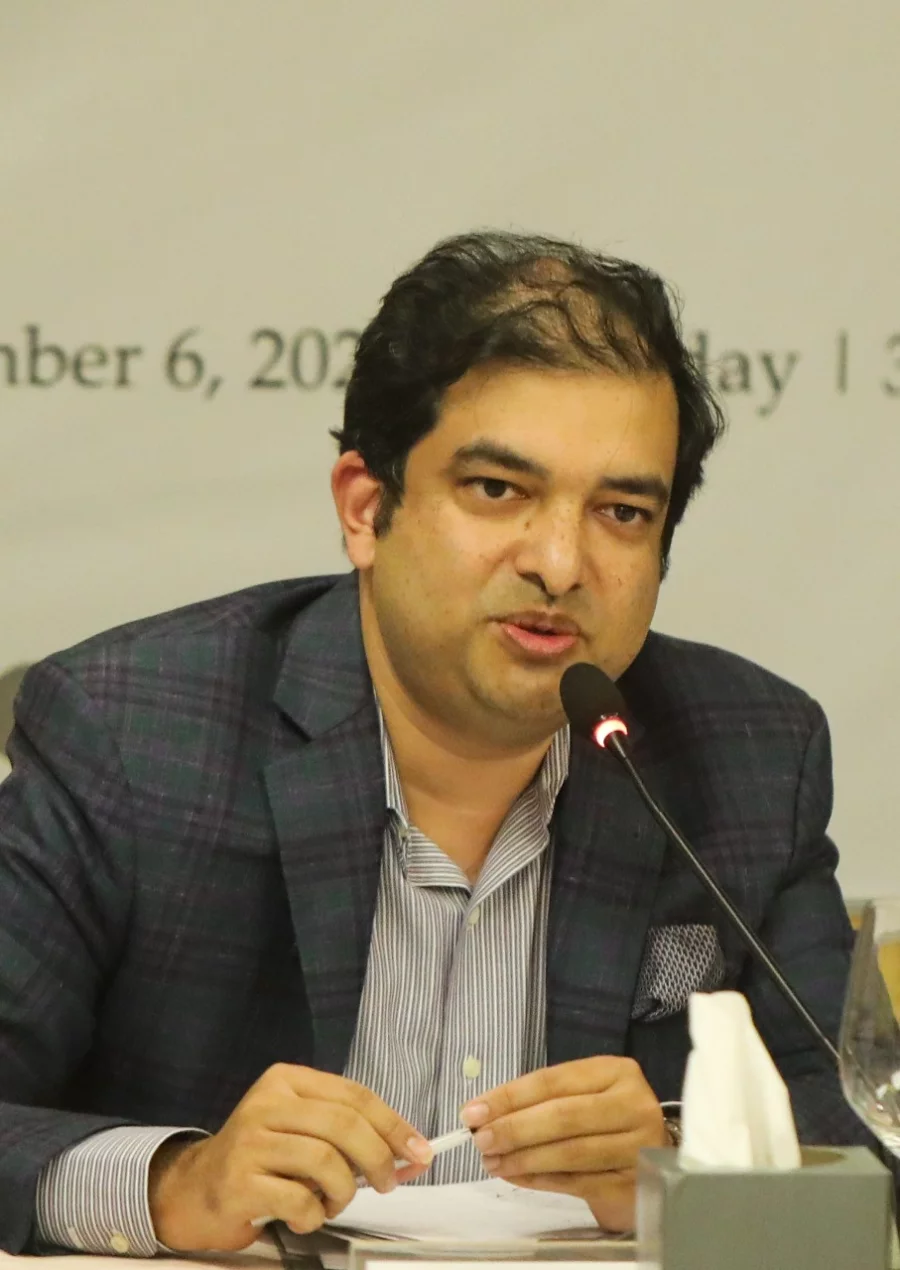
Kazi Inam Ahmed


Kazi Inam Ahmed:

‘The share of supermarkets still 2% of total retail sales for the past 20 years but have huge potential to unleash’ – Kazi Inam Ahmed, president of Bangladesh Supermarket Owners’ Association

The consumer does not pay VAT while purchasing goods from the open market, which is a factor in the supermarkets’ competitiveness.

“The main objective of our supermarket business is to provide consumers with a shopping experience in a beautiful and safe environment where food, fresh fruits and vegetables can be found under one roof, but people don’t want to go to supermarkets because of the extra VAT,” he said.


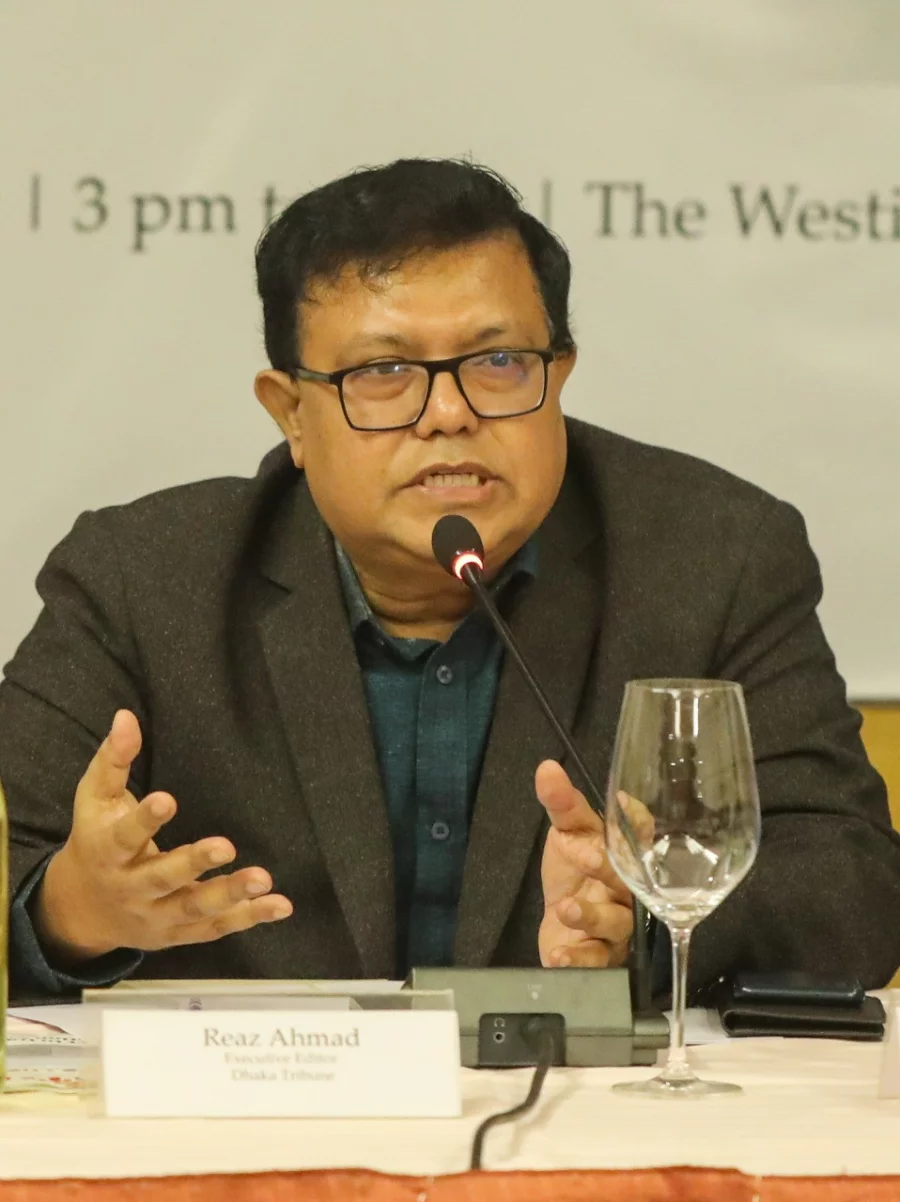
Reaz Ahmad

Reaz Ahmad:

‘It will not be unusual to have at least 10,000 supermarkets in Bangladesh compared to the country’s population if they get proper support’ – Reaz Ahmad, executive editor at Dhaka Tribune

Reaz Ahmad, the executive editor at Dhaka Tribune, said that over the past two decades, the supermarket has reached the stage it is today due to the sincerity of the entrepreneurs and also become highly appreciated at the consumer level.

“The share of supermarkets is still 2% of total retail sales for the past 20 years but has huge potential to unleash,” he said.

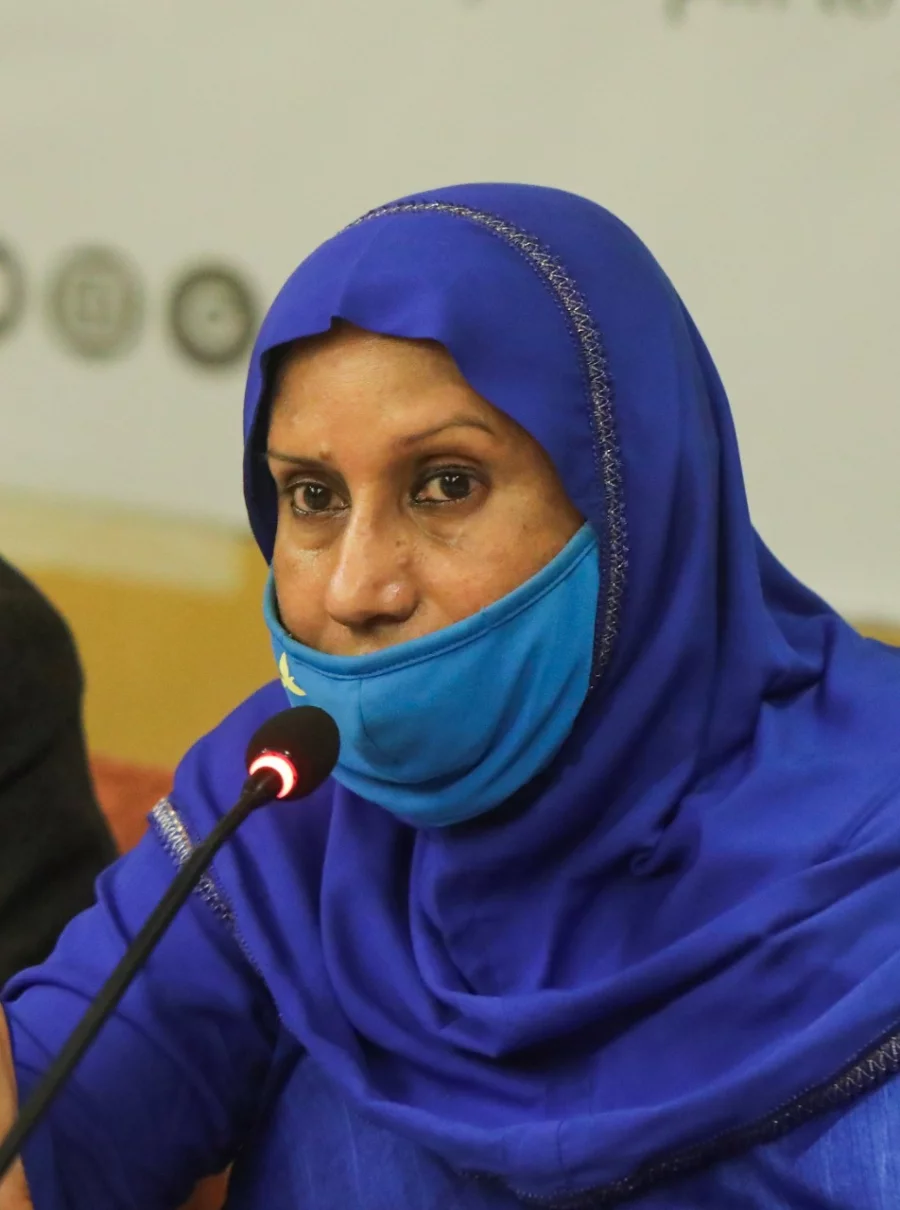
Nusrat Jabeen Banu, additional commerce secretary, said that the Ministry of Agriculture has the Agricultural Marketing Act which mentioned how to manage the supermarket and contract firm.


Nusrat Jabeen Banu

Nusrat Jabeen Banu:

‘Supermarkets should conduct business by maintaining ethics and goodwill as the consumers always prefer safe and secured products with fair price’ – Nusrat Jabeen Banu, additional commerce secretary

“We are ready to give adequate support to grow the sector. If the supermarket authority provides us with their demands, problems, and specific support in writing, surely, we will consider them with high priority,” she added.

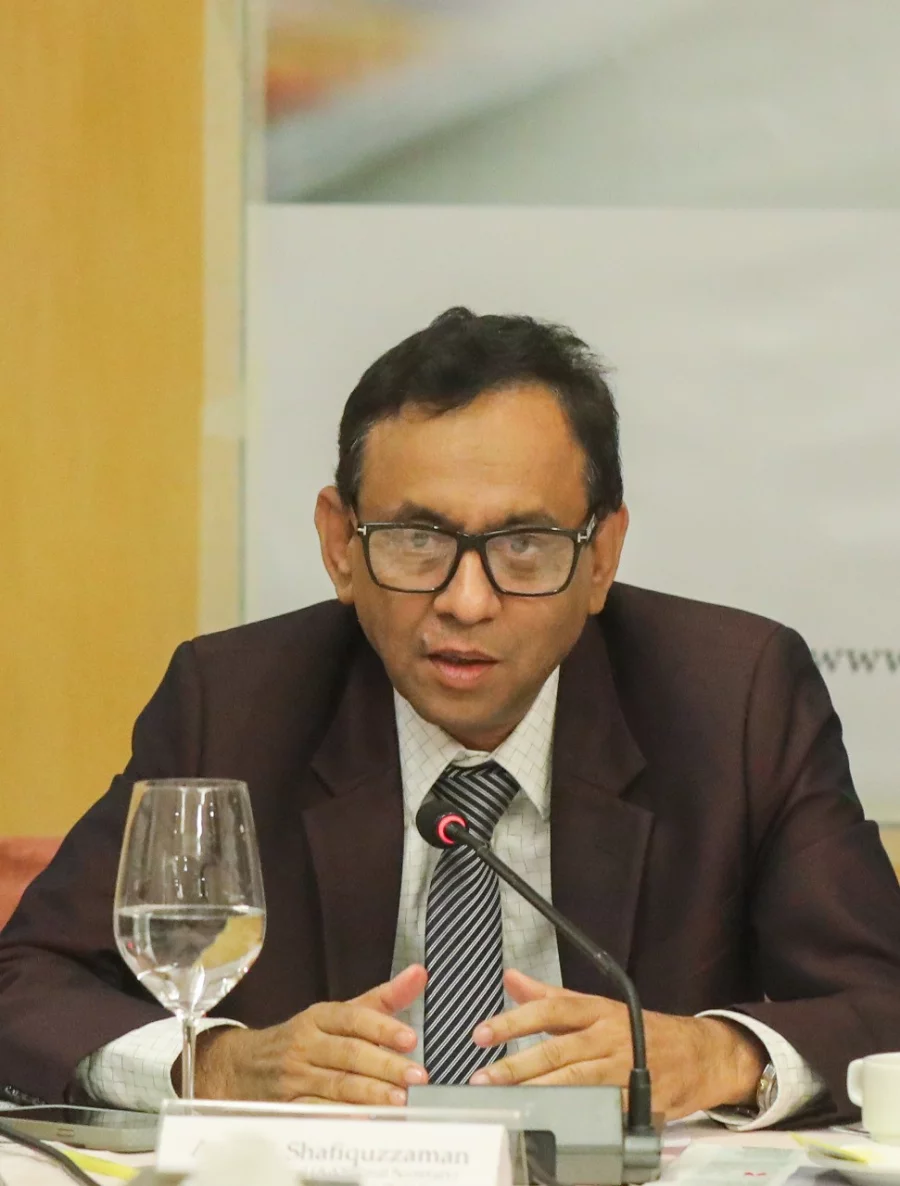
AHM Shafiquzzaman, director general at the Directorate of National Consumers Right Protection, said that Bangladesh is a country of 170 million people and its per capita income range was also growing and considering that, the contribution of supermarkets is still insignificant, he added.


AHM Shafiquzzaman

AHM Shafiquzzaman:

‘Supermarkets should inform consumers about details of the importers, retail price, and Customs information regarding imported products’ – AHM Shafiquzzaman, DG of Directorate of National Consumers Right Protection

The primary reason for this is the lack of trust and there are also differences in the prices between supermarkets and open markets.

Md Reazul Haque, deputy director of Bangladesh Standards and Testing Institution (BSTI), said: “Our suggestion to the supermarket owners is to keep following these things; mandatory licenses of 229 products, BSTI certificate and the information of importers if the products are imported, price tags and to check if BSTI logo is there or not.”


Md Reazul Haque

Md Reazul Haque:

‘Our suggestion to supermarket owners is to maintain mandatory licenses of 229 products, BSTI certificate, info of importers if products are imported, price tags and check if BSTI logo is there or not’ Md Reazul Haque Deputy Director at Bangladesh Standards and Testing Institution (BSTI)

Md Selim Reza, CEO, Dhaka North City Corporation, said: “There is an issue of trust.


Md Selim Reza

Md Selim Reza:

‘There is an issue of trust. However, price variation is very normal in the economic system of our country because maintaining ethics is the main challenge here’ – Md Selim Reza CEO of Dhaka North City CorporationMostak Hasan Md Iftekhar, founding chairman and general secretary of Bangladesh Food Safety Authority, said that 5% extra VAT for consumers is discriminatory.


Mostak Hasan Md Iftekhar

Mostak Hasan Md Iftekhar:

‘There are many regulations to ensure food safety in Bangladesh, but their proper coordination has not yet been possible’ Mostak Hasan Md Iftekhar, Founder chairman and GS, Bangladesh Food Safety Authority

Md Amin Helaly, vice-president of FBCCI, said that the supermarket is a new addition to the business sector and policymakers should take initiative to create more opportunities in this sector.


Md Amin Helaly

Md Amin Helaly:

‘The sector should move forward with its vision by adapting the challenges and building trusts. FBCCI is always ready to support this sector’ – Md Amin Helaly, vice president at FBCCIMalik Talha Islam Bari, director of Unimart, said that the industry can rise to the top if gets policy support and supermarkets will sure to grow if they get that.
Malik Talha Islam Bari

Malik Talha Islam Bari:

‘An industry can rise to the top if gets policy support and supermarkets will sure to grow if they get that’ – Malik Talha Islam Bari, director of Unimart

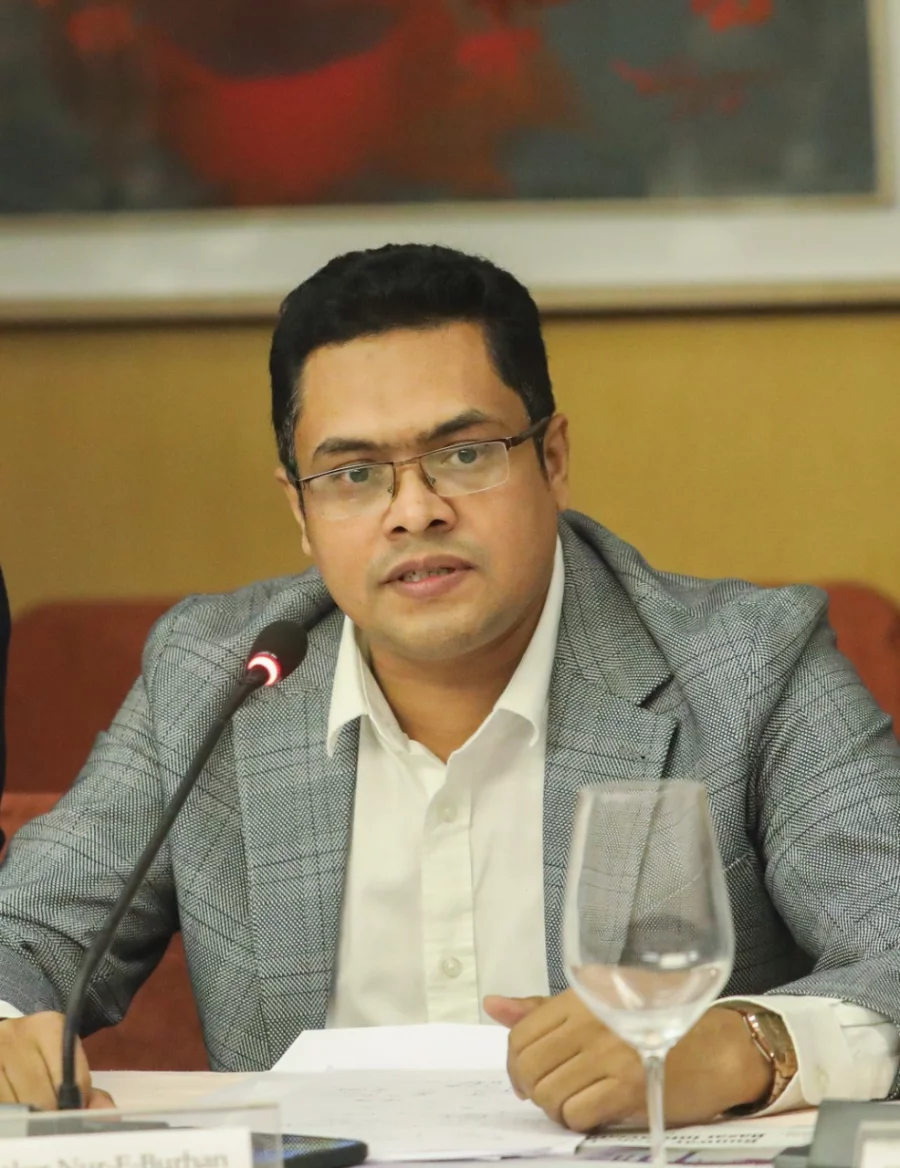
Khandaker Nur-E-Burhan, chief operating officer (COO) of Agora Limited said: “One of the challenges is that we are not able to balance between revenue, profit margin, and operational cost as 5% VAT is applicable on nearly 60%-65% of our products for which we can’t offer consumers a level playing field,” he added.


Khandaker Nur-E-Burhan

Khandaker Nur-E-Burhan:

‘One of the challenges is that we are not able to balance between revenue, profit margin, and operational cost as 5% VAT is applicable on nearly 60%-65% of our products’ Khandaker Nur-E-Burhan COO of Agora Ltd

Mahadi Faisal, head of marketing, Shwapno (ACI Logistics Ltd), said that the size of the retail business is Tk325,000 crore with around 1.8 million shops.


Mahadi Faisal

Mahadi Faisal:

The media can promote this sector more prominently’ Mahadi Faisal, head of marketing, Shwapno (ACI Logistics Ltd)

Galib Farrokh Bakht, COO, Pran-Daily Shopping, said that there is no policy regarding the area-based rent of commercial and other space though the rent accounts for 4% to 5% of the total cost.


Galib Farrokh Bakht

Galib Farrokh Bakht:

‘There is no policy regarding the area-based rent of commercial and other space though the rent accounts 4%-5% of total cost’ Galib Farrokh Bakht, COO of PRAN-Daily Shopping

“Moreover, we have to pay Tk12-Tk16 per unit for electricity bills while normal shops pay it as per residential rate,” he added, saying that electricity bills account for 2%-3% of the total cost.

Ahmed Shoyeb Iqbal, head of expansion, brand and online, Meena Bazar, said that they want a level-playing field for all.


Ahmed Shoyeb Iqbal

Ahmed Shoyeb Iqbal:

We want unified rules and regulations to follow which will ease the business’ – Ahmed Shoyeb Iqbal Head of Expansion, Brand and Online at Meena Bazar

“Respect all rules and regulations. We want unified rules and regulations to follow which will ease the business,” he added.

Dr Sahadev Chandra Saha, director (enforcement) of Bangladesh Food Safety Authority, said that supermarkets should start contract farming across the country which will ensure the consumers fresh and organic food products.

Dr Sahadev Chandra Saha

Dr Sahadev Chandra Saha:

‘Supermarkets should start contract farming across the country which will ensure the consumers fresh and organic food products’ – Dr Sahadev Chandra Saha Director (Enforcement) at Bangladesh Food Safety Authority


‘Policymakers should act by understanding their needs. The supermarket also has a role to play here, and the association should be proactive like the British Retail Consortium’ Engr M Liaquat Ali Asia Regional Director, United Certificates Services Limited

Dr Abdul Hannan Chowdhury

Dr Abdul Hannan Chowdhury:

‘We have to focus on home grown products, reducing transshipment cost, warehouse cost, equipment cost to reduce overall cost’ Dr Abdul Hannan Chowdhury, Professor at North South University


Zakir Hossain

Zakir Hossain:

‘The supermarkets played a vital role during the Covid-19 and we started home delivery for the first time’ Zakir Hossain, GS at Bangladesh Supermarket Owners’ Association

Kazi Inam Ahmed further said that they have to come up with a coordinated strategy and the Commerce Ministry should take the guardianship. “We all have the same goal; we want safe food at a good price in a safe environment. If this sector gets proper policy support, it can move forward to fulfill the goal,” he added.

MTI strategises for Dhaka Tribune in Bangladesh

MTI strategises for Dhaka Tribune in Bangladesh

Dhaka Tribune Editor-in-Chief Zafar Sobhan, MTI Consulting Bangladesh Country Director and Senior Consultant Saima Mazhar, Dhaka Tribune Publisher Dr. Kazi Anis Ahmed and Head of Operations Ahmed Shoyeb Iqbal

MTI Consulting have been closely working with Dhaka Tribune in several key areas since 2018 starting from setting DT’s long-term Vision, Mission and Values followed by re-organising DT and appointing key resources to bring about the desired change.

The project also included bringing policies and processes into place along with revamped performance management system with setting SMARTER KPIs. The Board and Management Review Committee continuously improve the process by incorporating structured and methodical reviews on a regular basis, with critical inputs.

‘Strategic Changes are driving revenues, curbing costs, and focusing on sustainability and profitability in parallel to the country and economic situation, both of which have been quite vulnerable in the last couple of years due to the outbreak of COVID.’ Dhaka Tribune has effectively laid out and implemented brand strategies to increase its brand leverage and take the newspaper to the next level.

Recently,

The newspaper launched a new state-of-the-art website to attract more readers and foster loyalty to the DT brand.
Dhaka Tribune Publisher Dr. Kazi Anis Ahmed said: “Our constant effort to take our newspaper to the next level has allowed us to make numerous positive changes which will certainly allow pave the way to gain our desired leadership position.”

MTI Consulting, an internationally networked boutique management consultancy, has carried out 680 projects across 49 countries in the last 25 years. MTI’s practices include Strategy, Operations, Re-organising, Performance Management, Digital, and Analytics. MTI Consulting with a 17-year history in Bangladesh has worked with many local conglomerates and industry verticals

Dhaka Tribune is one of the leading English Daily which envisage being the leading platform for news, views and ideas that will give Bangladesh a prosperous, progressive and powerful presence among nations and provide the readers with the most in-depth, insightful and intelligent news coverage and analysis.